Why Retaining Walls Fail in East Tennessee: How to Spot Trouble Early
Drive around Knoxville and East Tennessee long enough and you will see them: retaining walls leaning forward, bulging in the middle, or with one section dropped lower than the rest. Most did not fail in a single storm. They failed slowly, one wet season at a time, and showed warning signs long before anything tipped over.
Understanding why retaining walls fail helps in two ways. If you already have a wall, you can spot trouble while it is still a small fix. If you are planning a new wall, you can ask the right questions before the first block is set.
The most common cause is water with nowhere to go. East Tennessee gets heavy rain, and our clay-heavy soil holds that water instead of letting it drain away. Wet soil is heavy soil. When water builds up behind a wall, it pushes hard against the back of the blocks. A wall that looks fine in a dry summer can be under real pressure after a week of spring rain. That is why good walls are built with drainage in mind from the start, with clean gravel behind the wall and a way for water to escape instead of building up.
The second common cause is a weak base. A wall is only as steady as what it sits on. If blocks are set on soft or uneven ground, they settle unevenly as soil shifts. One section sinks, the next stays put, and soon joints start to open. Once joints open, more water gets in, soil washes out, and the problem speeds up. A firm, level, compacted base takes extra work on day one, but it is the part you can least afford to skip.
Poor backfill is a close third. If loose dirt or clay is simply shoved back behind a wall, it holds water, swells when wet, and shrinks when dry. That cycle works against the wall all year. Clean gravel backfill drains better, stays more stable, and does not push the same way clay does. Homeowners rarely see this layer once the job is done, which is why it is worth asking about before work begins.
Height and load catch people off guard, too. A short wall holding back a flower bed has an easy job. A taller wall holding back a sloped yard or a driveway edge has a much harder one. The higher the soil behind the wall, the more pressure it has to resist. Walls built too tall for their design, or that later have extra soil or a parking area added above them, can start to lean even if they looked solid at first.
Tree roots and freeze-thaw cycles add slower pressure. Roots can push from behind or lift from below. In winter, water trapped in soil freezes, expands, and thaws, working joints a little looser each year. Most failures are small stresses adding up over several seasons.
So what should you look for on a wall you already own? Start with the line. Stand at one end and look down the face. Is it straight, or is there a lean or a belly in the middle? Check for gaps opening between blocks, blocks that have shifted forward compared with their neighbors, and soil washing out at the base or through joints after rain. Look for wet spots that stay damp long after other ground has dried, and for cracks in the ground above the wall running parallel to it. Those cracks can mean the soil behind the wall is starting to move.
Not every sign means the wall has to come down. A small drainage problem caught early is a very different job from a wall that has leaned for years. The key is not to wait until a section falls. A fallen section lets the soil behind it go with it, and the repair gets bigger from there.
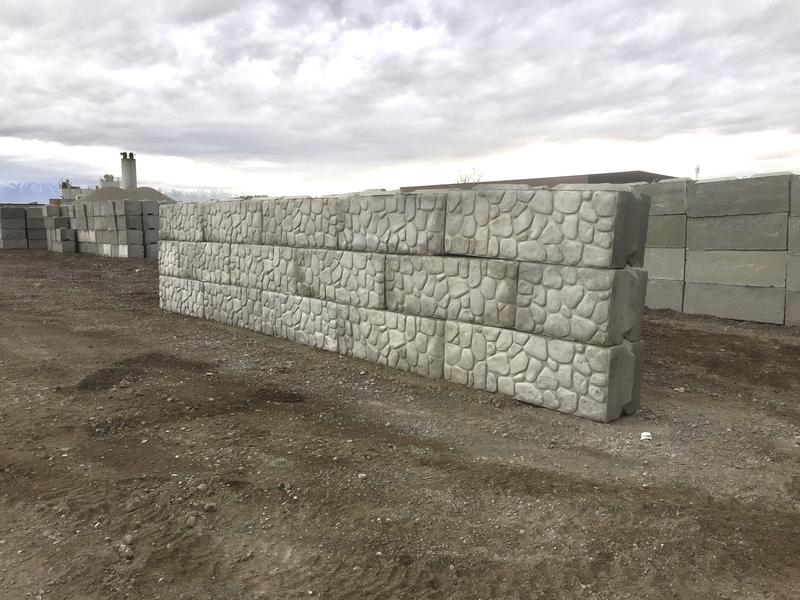
This is where large eco blocks help on new builds. East TN Retaining Walls builds with big concrete eco blocks, roughly two feet by two feet by four feet. Their sheer weight and size give a wall a lot of built-in resistance to the pressure wet clay puts on it, and they go in as full courses rather than hundreds of small pieces that can each shift on their own. They come in three finishes, plain, brown, and with a top cap, so a working wall can still look finished from the street and the yard.
Whether you choose eco blocks or another system, the questions to ask any builder are the same. How will water get out from behind the wall? What goes under the first course? What are you backfilling with? And is the wall designed for the height and the load it will actually carry, not just the height that looks good on paper? Clear answers to those four questions prevent most of the failures described above.
If you have a wall that is leaning, bulging, or draining poorly, or you are planning a new wall and want to get the base and drainage right the first time, we can help. Try the wall calculator on our site to get a block count for your project, then call (423) 358-2317 for a free estimate. We will look at the slope, the soil, and the water, and tell you plainly what the wall needs.
Want to know what your wall takes? Run the wall calculator for a block count, then send your details for a free estimate — no pressure, no obligation.