The First Course: Why the Buried Base Course Decides Everything
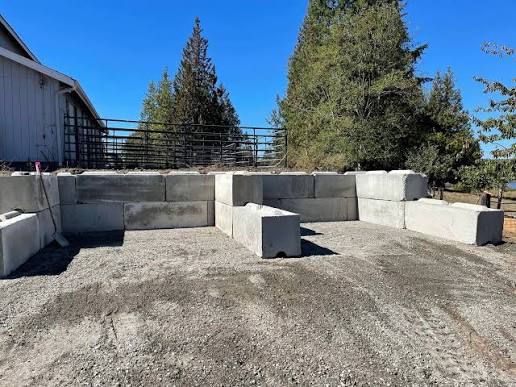
If you could watch only ten minutes of a retaining wall build, watch the first course go in. It is the least glamorous part of the job. The blocks sit mostly underground where nobody will ever admire them, the work is slow, and the crew spends as much time with a level and a shovel as with the blocks themselves. It is also the part that decides whether the wall is straight and solid in fifteen years or leaning and stepping apart in five. Every course above ground simply copies whatever the first course does.
The first course begins with the trench. That trench has to reach down through soft topsoil and loose, disturbed ground to firm material that will not compress or wander, and it has to be wide enough for the block and its gravel pad. In East Tennessee, that often means digging through the dark surface layer into the red clay beneath and confirming the bottom of the trench is consistent along the whole run. On a slope, the trench steps or stays level in sections so the base never climbs up out of the ground at the low end, which is a quiet failure that only shows itself years later.
On the floor of that trench goes the gravel pad. Clean gravel, spread to an even thickness, leveled, and compacted, does three jobs at once. It gives the first course a flat, uniform surface to sit on, so individual blocks are not rocking on high spots. It spreads the weight of the wall and the hillside over the ground below. And it drains, so water does not sit trapped under the base softening the soil and feeding frost movement in winter. Skipping or skimping the pad to save an hour is one of the most expensive shortcuts in wall building, because nobody can go back and add it later.
Setting the blocks themselves is a discipline of small corrections. Each eco block is roughly two feet tall, two feet deep, and four feet long, so it is heavy enough that setting it twice is real work, and that weight tempts people to accept close enough. Close enough is the enemy. Every block gets checked for level front to back, level along the run, and alignment with the string line or the planned curve, then adjusted with gravel until it sits dead true and does not rock. The joints between blocks are kept tight and consistent, because gaps and twists in the first course do not average out as the wall rises. They amplify.
How much of the first course stays buried matters too. Embedment is what keeps the base of the wall from sliding or being undermined when the ground in front of it gets wet, freezes, or is dug for planting. Taller walls and softer ground call for more of the course below grade. From the street, a finished wall with a properly buried first course simply looks grounded and intentional, with the visible courses starting at a clean line. A wall whose first course sits nearly on the surface often shows a raw, perched look even when it is brand new, and it has very little margin when the soil in front of it erodes.
Everything after this stage is comparatively straightforward, which is exactly the point. Drainage gravel and pipe go behind a wall that is already true. upper courses stack quickly and stay in line because they are following a level, locked-in base. Backfill compacts against a wall that is not being pushed out of shape by its own uneven footing. Even the top cap, in a plain or brown finish, sits better, because a level final course starts with a level first one. A good base does not just support the wall. It makes every later step easier to do well.
When you talk to any builder, ask them to describe how they set the first course, and listen for the words trench, firm ground, gravel, compacted, level, and buried. If those words come out naturally and in order, you are talking to someone who builds from the ground up. To plan your own wall, try the wall calculator on easttnretainingwalls.com for a starting estimate, or call (423) 358-2317 for a free estimate. We are happy to show you the base work on your site before it is covered, because that buried first course is the promise the rest of the wall keeps.
Want to know what your wall takes? Run the wall calculator for a block count, then send your details for a free estimate — no pressure, no obligation.