Retaining Wall vs. Riprap vs. Regrading: Three Ways to Hold a Slope
Every East Tennessee property owner with a slope eventually stands at the top of it weighing the same three options. Build a retaining wall and turn the slope into level ground. Cover the slope with riprap, the heavy angular stone used on banks and ditch lines, and armor it against erosion while leaving it a slope. Or regrade, moving earth until the slope is gentle enough to hold grass, shed water, and be maintained without drama. All three are legitimate.
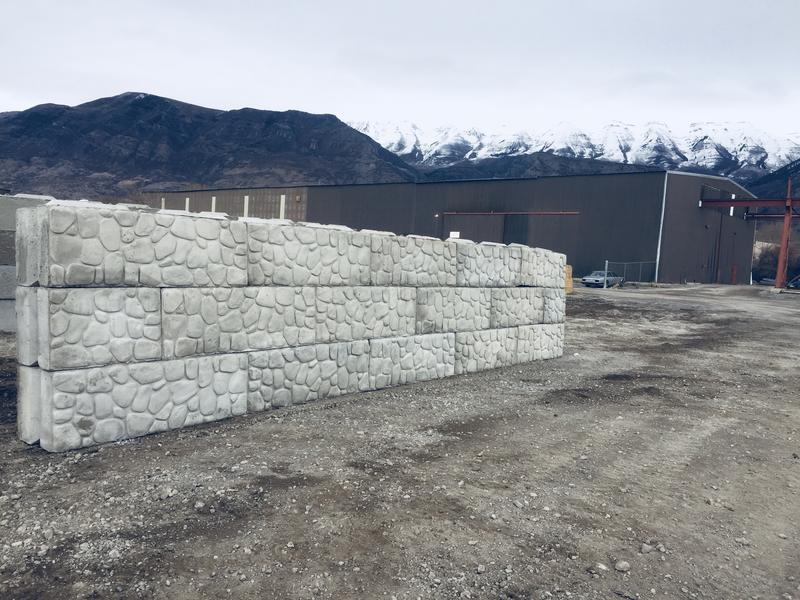
A retaining wall is the only option of the three that creates flat, usable space. That is its whole argument. Where a family needs a level yard, a pad, a parking area, a garden terrace, or a building site, a wall does what neither stone cover nor reshaping can: it holds a vertical edge so the ground above it can be genuinely flat right up to the line. Eco blocks, big concrete blocks about 2 by 2 by 4 feet in plain and brown finishes with a top cap option, build that edge with mass and a finished face. The wall's obligations are the known ones: a proper base, drainage behind the blocks, and a plan for the water the wall displaces. When the goal is usable level ground, those obligations are simply the price of the only tool that does the job.
Riprap is armor, not architecture. Heavy stone laid over a slope protects the soil beneath it from raindrop impact and running water, which is why you see it on road banks, ditch lines, and creek edges all over Knox, Hawkins, and Greene counties. It suits long, moderate slopes where nobody needs the ground to be flat and the enemy is erosion rather than unusable space. Its limits deserve honesty: riprap needs the slope beneath it to be stable to begin with, since stone cover will happily ride a sliding bank downhill one rock at a time. Weeds find it, leaves and sediment fill its voids over the years, and it is nobody's favorite surface to walk, mow around, or retrieve a ball from.
Regrading is the quiet option, and on the right lot it is the best one. If there is room to spread the slope out, moving soil to a gentler grade can leave you with ground that grows grass, drains without eroding, and asks nothing of any structure for the rest of its life. The costs are space and disruption: regrading consumes runout room at the top or bottom of the slope, it disturbs a large area that then needs to be re-established, and it moves the water question rather than answering it, because a newly gentle slope still has to shed a storm sensibly. On small lots in Knoxville or Maryville, there often simply is not room, and trying to regrade anyway just relocates a steep bank to the property line, where it becomes a shared problem with the neighbors.
Real properties often want a blend, and there is no rule against it. A wall where the family actually lives and parks, riprap on the long bank beyond the yard where only erosion matters, and regrading at the gentle margins to marry the two together is a common and sensible East Tennessee pattern. Creek and pond edges in particular often pair a wall at the access point with stone armor along the less-used reaches.
Choose by working backward from use, not forward from preference. Stand on the slope and answer three questions: Does any part of this ground need to be flat and usable? Is any part failing by erosion alone, on a slope that is otherwise stable? And is there truly room to soften the grade without creating a new problem at the edges? The answers usually sort the slope into sections on their own, and what remains is matching each section to its method and making sure the drainage of one does not undermine the next.
If you would like a second set of eyes on your slope, take photos from the top, the bottom, and both sides, and measure the drop and the length of the run. Try the wall calculator on the site to see what the wall portion of a blended plan might involve, or call (423) 358-2317 for a free estimate and an honest recommendation, even when the honest recommendation is that part of your hillside wants stone or a grader instead of blocks.
Want to know what your wall takes? Run the wall calculator for a block count, then send your details for a free estimate — no pressure, no obligation.