Eco Block Retaining Walls: Why East Tennessee Yards Are Going Big
Eco Block Retaining Walls: Why East Tennessee Yards Are Going Big
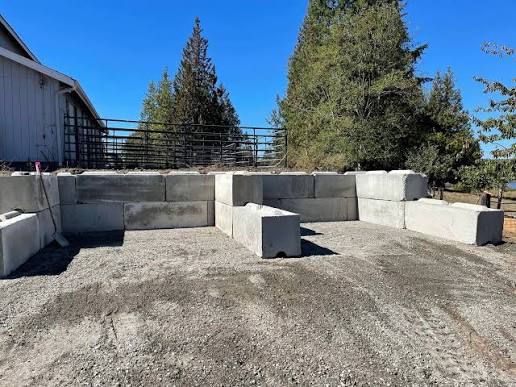
If you have driven through the hillier parts of Knoxville, Maryville, or Farragut lately, you may have noticed a change in how new retaining walls look. Instead of walls built from thousands of small hand-set blocks, more and more yards are held up by giant concrete blocks — roughly 2 by 2 by 4 feet each — stacked like stone dominoes. These are eco blocks, and they have quietly become one of the most practical ways to build a retaining wall in East Tennessee.
An eco block is a precast concrete block weighing around a ton. Each block does the work of roughly twenty to thirty small retaining-wall blocks, which changes the math on a project fast. Where a hand-built segmental wall might take a crew several days of laying block by block, an eco block wall goes up in a fraction of that time, because every placement moves a huge volume of wall at once. The blocks are set with equipment rather than by hand, so the wall grows in full courses in hours, not days.
That speed matters here in particular because of our soil. East Tennessee red clay holds water, and water is what pushes on a wall from behind. The longer a hillside sits opened up during construction, the longer it is exposed. A wall that goes up quickly spends less time as an open excavation, which is better for the slope and better for your yard. It also means less of your property is torn up and fewer days of equipment sitting in your driveway.
Another advantage of the big block is sheer mass. Retaining walls fail when the soil behind them pushes harder than the wall pushes back, and a ton of concrete per block is a lot of pushback. That mass makes eco block walls a natural fit for the tall, steep slopes you find all over Knox County and the surrounding hills — the kinds of slopes where a small-block wall would need extensive reinforcement just to hold still.
Drainage still rules everything. No wall, big or small, survives long without a way for trapped water to get out. A proper eco block installation includes gravel backfill behind the wall and drainage provisions that keep pressure from building up after one of our heavy spring downpours. The blocks are massive, but they are not magic — any contractor who tells you the size of the block means you can skip drainage is cutting a corner that will cost you later. When you talk to a builder, ask how they handle water behind the wall. It is the single most important question you can ask.
Eco blocks come with finish options, and that surprises a lot of homeowners who picture something industrial. The blocks are available in plain concrete, a brown tone that blends with wooded lots, and a top cap finish for the final course. The cap course is the part you will actually see from your patio, and it gives the wall a finished, intentional look instead of a construction-yard feel. On a sloped lot where the wall is the most visible thing in the backyard, that finished top edge makes a real difference.
Eco block walls are not right for every situation. If your wall is short — a foot or two of rise to terrace a garden bed, for example — the equipment needed to set ton-weight blocks may be overkill, and a smaller system can make more sense. Setbacks matter too: the machinery that places these blocks needs room to work, so tight backyards with limited access can be a constraint. A good contractor will look at your lot and tell you honestly whether the big-block approach fits.
What eco blocks are best for is the classic East Tennessee problem: a steep, unusable hillside eating up half your yard. A tall eco block wall turns that slope into flat, usable space — a bigger lawn, a patio, a play area — while holding the hill exactly where it is. Because each course is two feet tall, a five- or six-foot wall is only three courses, and the finished face has a bold, rugged character that suits the mountain setting.
When you are comparing builders, ask three things: how they handle drainage behind a big-block wall, what finish options they offer, and whether they have equipment access worked out for your specific lot. Those three answers will tell you almost everything about whether the job will be done right.
Want to see whether an eco block wall fits your yard? Try the wall calculator on our homepage to get a block count for your slope, then call (423) 358-2317 for a free estimate. We build eco block retaining walls across the Knoxville area and would be glad to take a look at your hillside.
Want to know what your wall takes? Run the wall calculator for a block count, then send your details for a free estimate — no pressure, no obligation.