Curved Retaining Walls With Big Blocks: How Corners and Curves Work
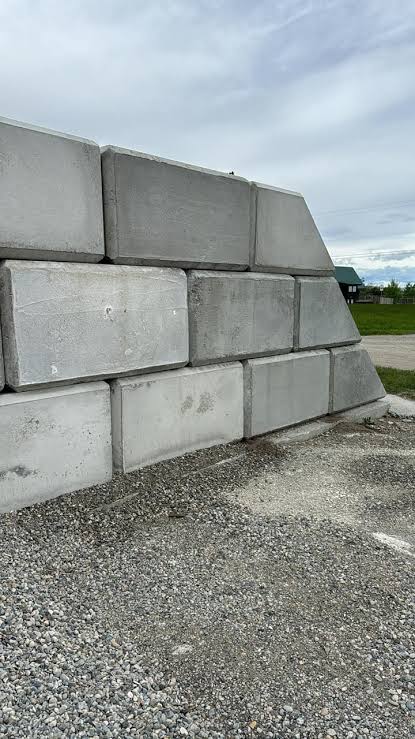
A straight wall is the simplest thing to build, but a lot of East Tennessee yards are not straight. Driveways sweep, patios round out, property lines angle, and hillsides roll in curves that a straight wall would cut across awkwardly. Homeowners looking at large eco blocks often assume blocks that big only go in straight lines. They do not. With large blocks, corners and gentle curves are very achievable. They just have to be planned as geometry from the start, not improvised when the run reaches the bend.
Start with the difference between a corner and a curve. A corner is a definite turn at a point, and with big rectangular blocks it is handled by cutting and fitting blocks so the two runs meet tightly and the courses stay interlocked and level through the turn. Corners are structural moments in a wall, because soil pressure pushes on both faces, and a well-fitted corner actually strengthens the run. A sloppy corner with wide, soil-filled joints is a weak spot that water and fines will find. The base trench has to turn the corner at the same level discipline as the straight sections, or the corner becomes the first place the wall steps out of line.
A curve with big blocks works by using the joints. Each block is straight and roughly two feet tall, two feet deep, and four feet long, so a curve is really a series of very slight angles, block to block, following an arc laid out on the ground before digging starts. The gentler and wider the radius, the tighter and more even those joints stay. Sweeping curves around a patio, along a driveway, or following the natural roll of a hillside suit large blocks well. Very tight, small-radius turns do not, because the fronts of the blocks meet while the backs gap open, or the other way around, and the wall loses the snug fit it needs.
Layout is where curved work is won or lost. The arc should be marked out fully, the trench dug to follow it, and the gravel base pad leveled along the curve before the first block is set. Every block in that buried first course has to be checked for level in two directions and for its angle against its neighbor, because a small error in the base arc grows course by course as the wall rises. Builders who are patient with the first curved course end up with a wall that looks effortless. Builders who rush it spend the rest of the job fighting a curve that wants to wander.
Drainage and backfill follow the same curve. The gravel zone and drain pipe behind the wall bend with the run, and the pipe needs to keep its fall toward the outlet even as it turns, which takes care on a long arc. Backfill is compacted in layers along the whole curve so no section is left loose to settle later. Concave curves, where the wall cradles the yard, and convex curves, where the wall bulges toward the viewer, behave a little differently in how soil loads them, and an experienced builder will talk through which one your lot is asking for and how the ends of the curve tie back into the slope so the wall does not simply stop in midair.
Finishing a curve is the detail people notice most. A top cap following a curve needs more cuts than a straight run, with each cap piece fitted so the top line flows without kinks. Eco blocks in plain and brown finishes both take a cap well, and on a curved wall the cap is worth the effort, because it is the flowing top edge that sells the shape from the house, the patio, and the street. Steps can also meet a curved wall cleanly when the meeting point is chosen during layout instead of discovered during the build.
If your yard wants a wall that turns or sweeps, bring a rough sketch of the shape and the length along the curve, not just a straight-line measurement. Try the wall calculator on easttnretainingwalls.com for a starting estimate, or call (423) 358-2317 for a free estimate. We will lay the line out on your ground with you, talk honestly about how tight a curve your space allows with big blocks, and build the corners and arcs so they look, and hold, like they were always part of the yard.
Want to know what your wall takes? Run the wall calculator for a block count, then send your details for a free estimate — no pressure, no obligation.